Research / Writing & evidence

Research, publications and policy analysis.

An integrated repository of published research, policy briefs, methodologies and commissioned studies. Explore concise summaries, then open the full evidence record, with clear distinctions between documented findings and later developments.

What is in the record

Different outputs, clearly attributed.

Some works were independently authored or co-authored; others were produced within institutional programmes or commissioned assignments. Attribution and public-release status are kept with each record.

10Published studies, briefs & methodologies
5Commissioned or non-public research records
3Broad subject areas for browsing
Research in context / Jordan, 2019–2024

Political-party governance and institutional reform.

Three separate NIMD contributions, best read together. Each has its own subject, chronology and source record.

How the subsequent law relates

Articles 7, 14 and 19 of Jordan’s 2022 Political Parties Law address internal governance, elected leadership, limits on consecutive secretary-general terms, and periodic party congresses. Article 19 also connects congress compliance to state-financing eligibility. The 2023 bylaw separately regulates funding arrangements; its electoral and inclusion incentives should not be mistaken for leadership-term rules.

These are substantive parallels between research findings and later legislation, not evidence of direct influence. The 2019 funding regulation already included provisions relating to women.

Published research

Explore by question or subject.

Filter published material without losing the underlying publication record. Publisher links and downloadable archival copies are available in the full entries.

Showing all 10 published entries.

Institutions & governance2024 online

Institutional methodology · Lead author

Evaluation Matrix for Political Parties in the Jordan Context

Developed a structured evaluation matrix enabling political parties and technical-assistance providers to assess institutional strengths and weaknesses beyond electoral results. The framework considers policy and programmes, internal democracy and…

Authors / research team: Wael Abu Anzeh Institutional credit: Netherlands Institute for Multiparty Democr…Full record & sources
Institutions & governance2021

Commissioned public policy brief · Sole author

Empowering Women in Jordanian Political Parties Using Public Financial Assistance

Authored a policy brief examining how public financial assistance to political parties could strengthen women’s participation, leadership and electoral representation in Jordan. The study reviewed existing political and electoral regulations and proposed…

Authors / research team: Wael Abu Anzeh Institutional credit: Masarat for Development & Progress | Embass…Full record & sources
Inclusion & society2020–2021

Institutional study · Researcher / co-author

Study of the Gender Gap Between Male and Female Schools in Ajloun, East Amman, Madaba and Tafila

Participated in research examining gendered disparities in learning environments and outcomes across 32 public schools in four areas of Jordan. The study combined desk review with community-level data gathering and consultations to investigate…

Authors / research team: Principal Researcher: Bashar Al-Khatib; Researchers: Rana Ibrahim Hassan and Wae…Full record & sources
Inclusion & society2020

Institutional study · Co-author

A Close Look at the Status of Women and Youth in Jordanian Professional Associations

Co-authored a baseline assessment examining women’s and young people’s representation, influence and participation in Jordanian professional associations. The study reviewed association structures, internal rules and leadership practices using desk…

Authors / research team: Bashar Al-Khatib; Wael Abu Anzeh Institutional credit: Arab Network for Civic Ed…Full record & sources
Institutions & governance2020 online

Institutional research · Lead author

Jordan Political Parties Budget Analysis

Authored a comparative analysis of the reported 2017 financial statements of 15 Jordanian political parties. The study examined public financing dependence, membership subscriptions, donations, salary and administrative costs, and expenditure on political…

Authors / research team: Wael Abu Anzeh Institutional credit: Netherlands Institute for Multiparty Democr…Full record & sources
Institutions & governance2020 online

Institutional brief · Lead author

Jordanian Parties’ Internal Democracy – Brief

Authored a comparative assessment of internal democratic practice and leadership rotation across 47 Jordanian political parties. The research analyzed how many individuals had occupied each party’s secretary-general position, their average tenure and…

Authors / research team: Wael Abu Anzeh Institutional credit: Netherlands Institute for Multiparty Democr…Full record & sources
Political economy & development2019

Co-authored political-economy research

Economic Policy in Jordan

Co-authored an extensive political-economy analysis of Jordan's economic policy and structural vulnerabilities. The research traced how domestic policymaking, regional and geopolitical developments, external assistance and reform programmes shaped economic…

Authors / research team: Dr. Yusuf Mansur; Bashar Al-Khatib; Wael Abu Anzeh Institutional credit: Rosa Lu…Full record & sources
Political economy & development2017

Co-authored institutional report

Work Opportunities for Syrians: An Analysis of Special Economic Zones as Vehicles for Economic Growth and Job Creation in Jordan

Co-authored an early empirical assessment of the employment strategy associated with the 2016 Jordan Compact. The report tested whether Special Economic Zones, preferential access to European markets and increased investment could create sustainable…

Authors / research team: Myrthe Toppen; Wael Abu Anzeh; Alistair Shawcross Institutional credit: Legatum …Full record & sources
Political economy & development2016

Collaborative research-team contribution

Re-Thinking Investment in Jordan

Contributed to a detailed analysis of Jordan’s investment climate and the effectiveness of policies intended to attract domestic and foreign capital. The research assessed legislation, regulatory barriers, fiscal incentives, access to finance,…

Authors / research team: Lead Researcher: Bashar Al-Khatib; Research Team: Aya Samara, Wael Abu Anzeh, My…Full record & sources
Inclusion & society2016

Research contribution · Individual authorship unconfirmed

Labour Demands Forecast Research: ICT, Health and Green Energy

Contributed to labour-market research examining mismatches between educational outcomes and employer demand in the ICT, healthcare and green-energy sectors. The study combined official employment statistics with interviews and questionnaires completed by…

Authors / research team: Research conducted by Identity Center ; individual named authorship requires con…Full record & sources
04 / 15 ENTRIES

Detailed publications & research records.

The complete available research archive, divided by public release status. Entries open to show institutional credit, your contribution and relevant evidence.

Prefer a quicker overview? Browse the research and writing index ↗. The full records and original source materials remain here.

Showing all 15 research entries.

Published research

All 10 entries · newest first
2024 onlineMethodology

Evaluation Matrix for Political Parties in the Jordan Context

Developed c. 2019; online publication 2024 | Lead Researcher & Author / Methodology Developer

Developed a structured evaluation matrix enabling political parties and technical-assistance providers to assess institutional strengths and weaknesses beyond electoral results. The framework considers policy and programmes, internal democracy and institutionalization, outreach, inclusion and geographical presence. Designed as an adaptable diagnostic rather than a rigid ranking tool, it was used in the design of a targeted political-party capacity-development approach. The assessment results for individual parties were not intended for public release.

View contributions, evidence & links

Authors / research team: Wael Abu Anzeh

Institutional credit: Netherlands Institute for Multiparty Democracy (NIMD)

Developed a structured evaluation matrix enabling political parties and technical-assistance providers to assess institutional strengths and weaknesses beyond electoral results. The framework considers policy and programmes, internal democracy and institutionalization, outreach, inclusion and geographical presence. Designed as an adaptable diagnostic rather than a rigid ranking tool, it was used in the design of a targeted political-party capacity-development approach. The assessment results for individual parties were not intended for public release.

Developed around 2019; the online publication date is 2024.

Original publication and official sources

Use in institutional development

The matrix was developed around 2019–2020 to inform diagnostic assessment and targeted support for political parties, and was later published by NIMD online in 2024. Its importance lies in connecting an analytical tool to a sequenced party-development approach. Later NIMD technical guides and voter-information initiatives are related programme developments, not outputs attributed to the matrix or to my authorship.

In context: Developed around 2019–2020 and published in 2024, the matrix is an organizational diagnostic framework, not a legislative drafting instrument. Read alongside the budget study and internal-democracy study, it demonstrates a combined approach to party governance, financial conditions and institutional assessment.

Institutional context: NIMD technical advisory work ↗

2021Published research

Empowering Women in Jordanian Political Parties Using Public Financial Assistance

2021 | Lead Researcher & Author

Authored a policy brief examining how public financial assistance to political parties could strengthen women’s participation, leadership and electoral representation in Jordan. The study reviewed existing political and electoral regulations and proposed 31 measures covering representation in internal party structures, candidate recruitment and list placement, campaigning, gender-responsive spending, dedicated women’s activities and financial incentives. The research framed public funding as a tool for changing party practices beyond election periods. Subsequent political-party, electoral and party-financing reforms introduced several comparable mechanisms. This is documented policy alignment, not proof of direct legislative adoption.

View contributions, evidence & links
Masarat · English and Arabic editions

Authors / research team: Wael Abu Anzeh

Institutional credit: Masarat for Development & Progress | Embassy of Canada in Jordan

Read or download archival copy

Original published document. Institutional credit and authorship are retained within each PDF.

Authored a policy brief examining how public financial assistance to political parties could strengthen women’s participation, leadership and electoral representation in Jordan. The study reviewed existing political and electoral regulations and proposed 31 measures covering representation in internal party structures, candidate recruitment and list placement, campaigning, gender-responsive spending, dedicated women’s activities and financial incentives. The research framed public funding as a tool for changing party practices beyond election periods. Subsequent political-party, electoral and party-financing reforms introduced several comparable mechanisms. This is documented policy alignment, not proof of direct legislative adoption.

Several recommendations align with later legal and financing reforms, but a direct causal influence has not been established.

Original publication and official sources
Related context and subsequent developments

Policy relevance / subsequent reforms

The 2021 Masarat brief proposed 31 mechanisms for women’s participation, representation and gender-responsive use of public assistance. Regulation No. 155 of 2019 already included gender-related financing conditions before the brief. Regulation No. 15 of 2023 later adopted a revised performance-linked formula, including additional funding linked to elected women, alongside youth and persons with disabilities. These are related policy themes, not evidence that the 2021 publication caused the revisions. Article 19’s congress/financing link belongs to the 2022 Political Parties Law, not the 2023 bylaw.

Institutional context: Masarat consultancy assignment ↗

2020–2021Published research

Study of the Gender Gap Between Male and Female Schools in Ajloun, East Amman, Madaba and Tafila

2020–2021 | Researcher & Co-Author

Participated in research examining gendered disparities in learning environments and outcomes across 32 public schools in four areas of Jordan. The study combined desk review with community-level data gathering and consultations to investigate infrastructure, resources, social norms, school-community relationships and educational barriers affecting boys and girls. Recommendations helped inform community-led initiatives involving schools, civil society organizations and families. The report is publicly available from ANHRE in connection with its gender-responsive community engagement project.

View contributions, evidence & links

Authors / research team: Principal Researcher: Bashar Al-Khatib; Researchers: Rana Ibrahim Hassan and Wael Abu Anzeh

Institutional credit: Arab Network for Civic Education (ANHRE) | USAID Takamol, implemented by IREX

Participated in research examining gendered disparities in learning environments and outcomes across 32 public schools in four areas of Jordan. The study combined desk review with community-level data gathering and consultations to investigate infrastructure, resources, social norms, school-community relationships and educational barriers affecting boys and girls. Recommendations helped inform community-led initiatives involving schools, civil society organizations and families. The report is publicly available from ANHRE in connection with its gender-responsive community engagement project.

English and Arabic editions are held in the author archive; permission for website redistribution has not been confirmed.

Original publication and official sources
Related context and subsequent developments

Institutional context: Applied gender assessment assignment ↗

2020Published research

A Close Look at the Status of Women and Youth in Jordanian Professional Associations

2020 | Researcher & Co-Author

Co-authored a baseline assessment examining women’s and young people’s representation, influence and participation in Jordanian professional associations. The study reviewed association structures, internal rules and leadership practices using desk research, stakeholder interviews and a questionnaire developed when pandemic restrictions limited conventional consultations. It identified institutional barriers and opportunities for inclusion and informed the Youth Academy for Democracy’s subsequent engagement and capacity-building work. A later ANHRE infographic summarizes the assessment; the infographic is not credited as my authored work.

View contributions, evidence & links

Authors / research team: Bashar Al-Khatib; Wael Abu Anzeh

Institutional credit: Arab Network for Civic Education (ANHRE) | Youth Academy for Democracy; Swedish IM-supported

Co-authored a baseline assessment examining women’s and young people’s representation, influence and participation in Jordanian professional associations. The study reviewed association structures, internal rules and leadership practices using desk research, stakeholder interviews and a questionnaire developed when pandemic restrictions limited conventional consultations. It identified institutional barriers and opportunities for inclusion and informed the Youth Academy for Democracy’s subsequent engagement and capacity-building work. A later ANHRE infographic summarizes the assessment; the infographic is not credited as my authored work.

The infographic summarizes research findings; it is not individually authored by the researcher.

Original publication and official sources
Related context and subsequent developments

Use beyond the study

This baseline assessment supported the Youth Academy for Democracy’s work on inclusion in professional associations. A later ANHRE infographic made the findings more accessible. The infographic and subsequent programming are related organizational outputs, not publications claimed as my individual work.

Institutional context: Advisory assignment ↗

2020 onlinePublished research

Jordan Political Parties Budget Analysis

Research 2019; NIMD online release 2020 | Lead Researcher & Author

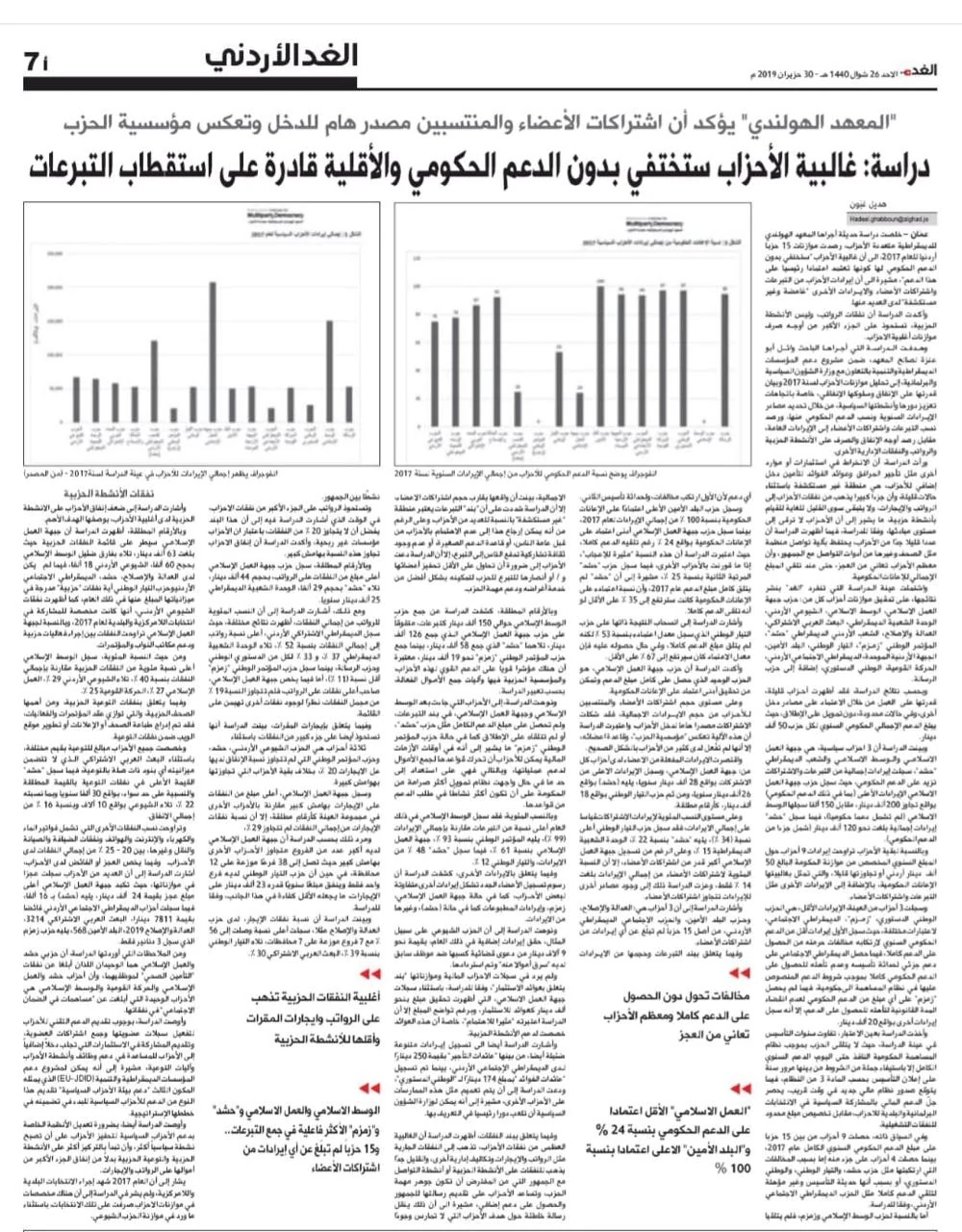
Authored a comparative analysis of the reported 2017 financial statements of 15 Jordanian political parties. The study examined public financing dependence, membership subscriptions, donations, salary and administrative costs, and expenditure on political activity. It identified structural challenges to financial sustainability and discussed implications for party institutionalization. The study received extensive national media coverage in Al-Ghad and was cited by political researcher E.J. Karmel in a November 2020 Middle East Report (MERIP) analysis of Jordan’s parliamentary elections. It was published during an active period of discussion about party financing, but the website does not attribute confidential policy advice or particular later bylaw provisions to the study.

View contributions, evidence & links
Al-Ghad newspaper coverage of a NIMD study on the finances of 15 Jordanian political parties, featuring two charts and a headline in Arabic
Al-Ghad newspaper coverage of the political-party budget analysis (2019). Source: Al-Ghad.

Authors / research team: Wael Abu Anzeh

Institutional credit: Netherlands Institute for Multiparty Democracy (NIMD)

Authored a comparative analysis of the reported 2017 financial statements of 15 Jordanian political parties. The study examined public financing dependence, membership subscriptions, donations, salary and administrative costs, and expenditure on political activity. It identified structural challenges to financial sustainability and discussed implications for party institutionalization. The study received extensive national media coverage in Al-Ghad and was cited by political researcher E.J. Karmel in a November 2020 Middle East Report (MERIP) analysis of Jordan’s parliamentary elections. It was published during an active period of discussion about party financing, but the website does not attribute confidential policy advice or particular later bylaw provisions to the study.

Research was conducted in 2019 and released on NIMD’s website in 2020.

Original publication and official sources
Citations and educational use

Public and policy relevance

The analysis documented heavy dependence on state support, limited self-generated revenue and the balance between administration and political activity across 15 parties. It received national newspaper coverage and was subsequently cited in independent commentary on Jordan’s 2020 parliamentary elections. The 2023 financing bylaw later placed greater emphasis on electoral performance and representation. The research and later reform address overlapping challenges, without establishing a direct causal connection.

Distinguishing finance research from later rules

The 2019 study examined financial sustainability and financing practices among 15 parties. The 2023 financing bylaw later changed the funding formula and provides for certain electoral and representation-related incentives; it did not create the 2022 law’s secretary-general term limits. The findings and policy changes concern overlapping institutional challenges, without established causal influence.

Institutional context: NIMD technical advisory work ↗

2020 onlinePublished research

Jordanian Parties’ Internal Democracy – Brief

Research 2019; NIMD online release 2020 | Lead Researcher & Author

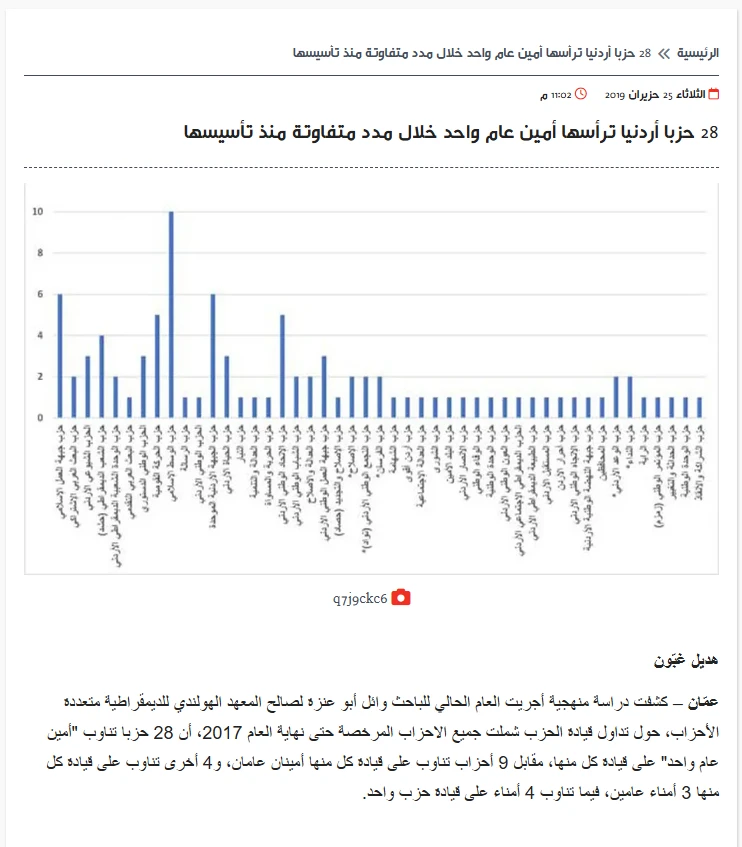
Original 2019 study of leadership rotation in 47 Jordanian political parties, using data covering parties licensed through 2017. Twenty-eight had retained a single secretary-general since founding. Al-Ghad reported the findings in 2019. The later 2022 Political Parties Law addresses some of the same internal-governance challenges, but direct legislative influence is not established.

View contributions, evidence & links
Screenshot of Al-Ghad report about secretary-general leadership rotation across Jordanian parties, showing chart and Arabic headline
Al-Ghad reporting on the internal-democracy study (2019). Source: Al-Ghad.

Authors / research team: Wael Abu Anzeh

Institutional credit: Netherlands Institute for Multiparty Democracy (NIMD)

Authored a comparative assessment of internal democratic practice and leadership rotation across 47 Jordanian political parties. The research analyzed how many individuals had occupied each party’s secretary-general position, their average tenure and differences associated with party age and succession practices. It documented that 28 parties had experienced a single secretary-general since their founding. Published as a companion to the budget analysis, the study generated substantial Al-Ghad coverage and contributed evidence to public discussion about institutional development and party governance.

Research undertaken in 2019; published online in 2020.

Original publication and official sources
Media coverage and subsequent use

Public discussion and policy context

The comparison of leadership succession across 47 parties—including the finding that 28 had retained one secretary-general since founding—received press coverage and contributed evidence to public discussion about party institutionalization. Subsequent political-party reforms expanded attention to participation and internal organization. Similar subject matter does not establish that the brief shaped specific legal provisions.

What the evidence supports

Research finding: The study analyzed leadership rotation, tenure and succession, noting that party age and leadership changes caused by death can affect interpretation. Subsequent legislation: Article 14 of Law No. 7 of 2022 limits the secretary-general to two consecutive terms, each of no more than four years; Article 19 requires periodic party congresses and links compliance to financing eligibility. Article 7 addresses parties’ constitutional rules and internal procedures.

Attribution: The chronology and thematic overlap are documented. The available publications do not establish that this research directly caused those provisions.

Institutional context: NIMD technical advisory work ↗

2019Published research

Economic Policy in Jordan

2019 | Researcher & Co-Author | Public launch: 18 June 2019, Amman

Co-authored an extensive political-economy analysis of Jordan's economic policy and structural vulnerabilities. The research traced how domestic policymaking, regional and geopolitical developments, external assistance and reform programmes shaped economic outcomes. It examined growth, public debt, IMF programmes, remittances, taxation, government expenditure and privatization, including the port, mining and electricity sectors. Combining historical and macroeconomic analysis with interviews and policy assessment, the study developed recommendations on structural economic challenges and resilience.

View contributions, evidence & links

Authors / research team: Dr. Yusuf Mansur; Bashar Al-Khatib; Wael Abu Anzeh

Institutional credit: Rosa Luxemburg Stiftung, Regional Office Palestine & Jordan | Funded by the German Federal Ministry for Economic Cooperation and Development (BMZ)

Co-authored an extensive political-economy analysis of Jordan's economic policy and structural vulnerabilities. The research traced how domestic policymaking, regional and geopolitical developments, external assistance and reform programmes shaped economic outcomes. It examined growth, public debt, IMF programmes, remittances, taxation, government expenditure and privatization, including the port, mining and electricity sectors. Combining historical and macroeconomic analysis with interviews and policy assessment, the study developed recommendations on structural economic challenges and resilience.

The report was published by Rosa Luxemburg Stiftung in June 2019 and formally launched in Amman on 18 June 2019, when the researchers presented their findings and engaged in discussion with scholars, civil society representatives and other participants.

These are selected documented citations and teaching uses, not a comprehensive citation count.

Research uptake and relevance

Following publication and a public launch in 2019, this political-economy analysis was referenced in subsequent academic and policy-oriented research on Jordan’s economy and political conditions. These citations demonstrate that the study has been used by later researchers, not that it directly caused economic-policy changes.

Institutional context: Political-economy research and advisory record ↗

2017Published research

Work Opportunities for Syrians: An Analysis of Special Economic Zones as Vehicles for Economic Growth and Job Creation in Jordan

2017 | Researcher & Co-Author

Co-authored an early empirical assessment of the employment strategy associated with the 2016 Jordan Compact. The report tested whether Special Economic Zones, preferential access to European markets and increased investment could create sustainable employment for Syrian refugees and Jordanians. Combining economic and policy analysis with factory interviews, stakeholder consultations and focus groups with Syrian refugees, the study identified regulatory and institutional constraints, difficult working conditions and weaknesses in the proposed employment model. It advanced recommendations for economic development and labour-market inclusion grounded in evidence from the Compact's early implementation.

View contributions, evidence & links
Legatum Institute / Identity Center · May 2017

Authors / research team: Myrthe Toppen; Wael Abu Anzeh; Alistair Shawcross

Institutional credit: Legatum Institute, in partnership with Identity Center | Supported by the Legatum Foundation

Read or download archival copy

The publisher website is linked for attribution; the report is not hosted here because redistribution permission has not been confirmed.

Original published document. Institutional credit and authorship are retained within each PDF.

Co-authored an early empirical assessment of the employment strategy associated with the 2016 Jordan Compact. The report tested whether Special Economic Zones, preferential access to European markets and increased investment could create sustainable employment for Syrian refugees and Jordanians. Combining economic and policy analysis with factory interviews, stakeholder consultations and focus groups with Syrian refugees, the study identified regulatory and institutional constraints, difficult working conditions and weaknesses in the proposed employment model. It advanced recommendations for economic development and labour-market inclusion grounded in evidence from the Compact's early implementation.

This archival copy is provided alongside source and academic citation links. The report was published in 2017.

Subsequent research uptake

The study examined the early labour-market assumptions behind the Jordan Compact and Special Economic Zone employment model. It was later cited in academic analysis of refugee labour-market integration, documenting uptake in subsequent research rather than implementation of its recommendations.

Institutional context: Identity Center programme work ↗

2016Published research

Re-Thinking Investment in Jordan

2016 | Researcher & Co-Author

Contributed to a detailed analysis of Jordan’s investment climate and the effectiveness of policies intended to attract domestic and foreign capital. The research assessed legislation, regulatory barriers, fiscal incentives, access to finance, labour-market conditions and Special Economic Zones, drawing on policy review and stakeholder perspectives. It identified structural obstacles and advanced recommendations to improve the investment environment while increasing economic benefits for Jordan. The study was referenced in later academic discussion of the Jordan Compact and economic zones.

View contributions, evidence & links
Identity Center / Adam Smith International · 2016

Authors / research team: Lead Researcher: Bashar Al-Khatib; Research Team: Aya Samara, Wael Abu Anzeh, Myrthe Toppen and Annie Hamill

Institutional credit: Identity Center | Adam Smith International | UK Aid support

Read or download archival copy

The publisher website is linked for attribution; the report is not hosted here because redistribution permission has not been confirmed.

Original published document. Institutional credit and authorship are retained within each PDF.

Contributed to a detailed analysis of Jordan’s investment climate and the effectiveness of policies intended to attract domestic and foreign capital. The research assessed legislation, regulatory barriers, fiscal incentives, access to finance, labour-market conditions and Special Economic Zones, drawing on policy review and stakeholder perspectives. It identified structural obstacles and advanced recommendations to improve the investment environment while increasing economic benefits for Jordan. The study was referenced in later academic discussion of the Jordan Compact and economic zones.

English and Arabic editions are held in the author archive; redistribution rights are not yet confirmed.

Subsequent research relevance

The study evaluated structural barriers and incentives in Jordan’s investment environment and Special Economic Zones. Related issues were addressed in later academic discussion of the Jordan Compact and employment policy. The relationship is framed as thematic and citation-based relevance, not a claim that investment reforms followed from the report.

Institutional context: Identity Center programme work ↗

2016Published research

Labour Demands Forecast Research: ICT, Health and Green Energy

2016 | Researcher & Co-Author (self-reported contribution)

Contributed to labour-market research examining mismatches between educational outcomes and employer demand in the ICT, healthcare and green-energy sectors. The study combined official employment statistics with interviews and questionnaires completed by 57 companies, 23 in ICT, 22 in healthcare and 12 in green energy, to assess recruitment needs, skill gaps and sector prospects. It developed recommendations for better alignment of training and education with Jordan’s evolving labour market.

View contributions, evidence & links

Authors / research team: Research conducted by Identity Center; individual named authorship requires confirmation

Institutional credit: Business Development Center (BDC) | UK Aid support

Contributed to labour-market research examining mismatches between educational outcomes and employer demand in the ICT, healthcare and green-energy sectors. The study combined official employment statistics with interviews and questionnaires completed by 57 companies, 23 in ICT, 22 in healthcare and 12 in green energy, to assess recruitment needs, skill gaps and sector prospects. It developed recommendations for better alignment of training and education with Jordan’s evolving labour market.

The contribution as researcher/co-author is based on the professional record; named authorship in the report itself still requires confirmation.

Original publication and official sources

Commissioned · not publicly released

All 5 entries · newest first

These reports are described at a high level. Their documents are not available for download, as authorization for public distribution has not been established.

2021Commissioned · not public

EU Jordan Country Conflict Analysis (2021)

Researcher & Co-Author | Prepared for EU Delegation to Jordan | Authors: Bashar Al-Khatib and Wael Abu Anzeh

Co-authored a country conflict analysis examining drivers of instability in Jordan across domestic politics, regional geopolitics, rule of law, economic development and environmental pressures. Combining desk research and expert/stakeholder engagement, the report identified risks and recommendations intended to support conflict-sensitive programming and strategic development planning. This was a commissioned institutional report, not a public publication.

View contributions, evidence & links

Co-authored a country conflict analysis examining drivers of instability in Jordan across domestic politics, regional geopolitics, rule of law, economic development and environmental pressures. Combining desk research and expert/stakeholder engagement, the report identified risks and recommendations intended to support conflict-sensitive programming and strategic development planning. This was a commissioned institutional report, not a public publication.

Commissioned institutional material. No report download is provided because public distribution is not authorized.

2020Commissioned · not public

Integrating Youth in Developmental Processes (2020)

Researcher & Co-Author | Mercy Corps Jordan, through Lawyers Without Borders | Authors: Wael Abu Anzeh and Dr. Saddam Abu Azzam | DFID-supported context

Co-authored a policy paper examining legal, administrative and public-finance obstacles to youth involvement in local development planning and decision-making in Jordan. The work drew on decentralization and municipal legislation, youth policy, government budgets and consultation evidence to propose options for participation, institutional reform and youth-led engagement, including shadow councils and monitoring mechanisms. Prepared for institutional use only.

View contributions, evidence & links

Co-authored a policy paper examining legal, administrative and public-finance obstacles to youth involvement in local development planning and decision-making in Jordan. The work drew on decentralization and municipal legislation, youth policy, government budgets and consultation evidence to propose options for participation, institutional reform and youth-led engagement, including shadow councils and monitoring mechanisms. Prepared for institutional use only.

Commissioned institutional material. No report download is provided because public distribution is not authorized.

2019–2020Commissioned · not public

Jordan Integrity and Anti-Corruption Commission — Twinning Preparation (2019–2020)

Governance Researcher / Key Expert | Lawyers Without Borders / EU Delegation; part of an expert consultancy team

Served as a key expert in institutional and legal assessment work supporting the development of a proposed EU Twinning arrangement for Jordan’s Integrity and Anti-Corruption Commission. The preparatory consultancy produced research and technical recommendations and a draft Twinning Fiche. The report itself was prepared for internal institutional use. A subsequent, modified public Twinning Fiche and later programme implementation are related outcomes, not documents identical to the original consultancy deliverables.

View contributions, evidence & links

Served as a key expert in institutional and legal assessment work supporting the development of a proposed EU Twinning arrangement for Jordan’s Integrity and Anti-Corruption Commission. The preparatory consultancy produced research and technical recommendations and a draft Twinning Fiche. The report itself was prepared for internal institutional use. A subsequent, modified public Twinning Fiche and later programme implementation are related outcomes, not documents identical to the original consultancy deliverables.

Commissioned institutional material. No report download is provided because public distribution is not authorized.

Related publicly documented programme

The original commissioned assessment and draft fiche were preparatory and are not publicly distributed. A public Twinning Fiche describes cooperation on integrity standards and corruption-risk assessment; the EU subsequently reported a programme launch in 2021 and completion in 2022. These are later institutional records, not evidence that I managed programme implementation or that the public document was identical to the original internal draft.

2018Commissioned · not public

Jordan Fragility Assessment (2018)

Researcher & Co-Author | Mercy Corps | Researchers: Dr. Yusuf Mansur, Bashar Al-Khatib, Manar Rachwani and Wael Abu Anzeh

Co-authored a multidimensional assessment of Jordan’s political, economic, institutional and regional vulnerabilities. The research team adapted relevant stability and fragility frameworks to Jordan’s context, developed an analytical index and examined power structures, inclusive growth, conflict-resolution arrangements, institutional legitimacy and regional factors. The findings were prepared to inform programme and policy decisions; the assessment was not intended for public release.

View contributions, evidence & links

Co-authored a multidimensional assessment of Jordan’s political, economic, institutional and regional vulnerabilities. The research team adapted relevant stability and fragility frameworks to Jordan’s context, developed an analytical index and examined power structures, inclusive growth, conflict-resolution arrangements, institutional legitimacy and regional factors. The findings were prepared to inform programme and policy decisions; the assessment was not intended for public release.

Commissioned institutional material. No report download is provided because public distribution is not authorized.

2015–2017Commissioned · not public

Child-Focused Public Finance & Budget Analysis in Jordan (2015–2017)

Lead Researcher & Author | UNICEF Jordan, implemented through Identity Center

Led research and preparation of a series of national and sector budget briefs examining how public resources were allocated and spent in areas affecting children and vulnerable populations. The work covered the national budget, education, health, social protection, child protection and early childhood development. It combined multi-year expenditure comparisons, budget execution, sector performance indicators and programme-policy analysis to support informed institutional discussion of child-responsive budgeting, fiscal priorities and transparency. The materials were commissioned for institutional use and were not released publicly.

View contributions, evidence & links

Led research and preparation of a series of national and sector budget briefs examining how public resources were allocated and spent in areas affecting children and vulnerable populations. The work covered the national budget, education, health, social protection, child protection and early childhood development. It combined multi-year expenditure comparisons, budget execution, sector performance indicators and programme-policy analysis to support informed institutional discussion of child-responsive budgeting, fiscal priorities and transparency. The materials were commissioned for institutional use and were not released publicly.

Commissioned institutional material. No report download is provided because public distribution is not authorized.

No research entries match your search.

Contact

Discuss research or institutional collaboration.

For related research, advisory or professional engagements.