Professional experience, research and advisory work.
Browse the professional record by type of work, in reverse chronological order. Expand entries to see responsibilities, selected contributions, evidence and links. Where the record supports it, short notes distinguish subsequent research uptake or related reforms from impacts that can be attributed directly.
Full-time positions.
All documented substantive roles are shown below. The DRI interim Project Manager assignment is identified as concurrent, not a separate period of employment.
2025–presentPositionProject Manager — Doha Global South Health Policy Initiative
Manage the planning and delivery of a global health policy initiative that brings together policy dialogue, applied research, capacity development and country-level catalytic interventions. The role combines programme management with institutional partnerships, donor coordination and policy engagement across the Global South.
Responsibilities and contributions
- Coordinate implementation plans, milestones, deliverables, budgets and reporting, ensuring that technical workstreams and convenings progress in line with agreed priorities.
- Support the design and operational follow-up of country-level catalytic pilot interventions, translating policy priorities and stakeholder feedback into feasible implementation concepts.
- Coordinate engagement with government representatives, international organizations, researchers, implementing partners and donors, including the Global Fund and Qatar-based institutions.
- Manage preparations for high-level policy convenings, technical discussions, professional-development activities and a practitioner community of practice, including content coordination and logistics.
- Contribute to research and knowledge products, partner mapping and donor-facing progress reporting, linking evidence, policy discussion and practical programme delivery.
Original publication and official sources
2023PositionProject Manager — Words Matter (Interim)
Assumed interim project-management responsibility during the final phase of Words Matter, a multi-country initiative addressing disinformation, hate speech and online gender-based violence in Jordan, Lebanon, Sudan and Tunisia. The assignment required coordinating regional implementation, research outputs, partner delivery and close-out activities.
Responsibilities and contributions
- Led day-to-day coordination across country teams, technical researchers and six implementing partners, aligning regional activities, responsibilities and reporting deadlines.
- Oversaw implementation and expenditure follow-up, procurement and donor-compliance processes, while supporting monitoring and evaluation, gender-sensitive programming and risk management.
- Coordinated development and finalization of research and monitoring outputs on online public discourse, including collaboration across analysts, programme teams and communications colleagues.
- Managed preparation of the three-day Words Matter Regional Forum in October 2023, including programme content, partner and speaker coordination, and adjustments to delivery arrangements in response to regional security developments.
- Supported final project reporting, knowledge exchange and the transition from implementation to close-out.
Interim assignment undertaken alongside the Programme Coordinator position; not a separate period of full-time employment.
Professional evidence and documented contributions
Related context and subsequent developments
Documented output and wider relevance
The project’s final regional reporting documents research and programming on disinformation, hate speech and online gender-based violence. It records the management contribution within a collective programme delivered across four countries; no subsequent legislative or behavioural change is attributed to my individual role.
2022–2025PositionProgramme Coordinator — MENA
Coordinated a portfolio of regional democratic-governance, digital-rights and civic-engagement programmes across the Middle East, North Africa and West Africa. Worked across multiple country offices and partnerships to maintain delivery quality, contractual compliance and coordination among programme, research and technical teams.
Responsibilities and contributions
- Coordinated implementation planning, workplans, budgets, procurement, subgrants, consultant contracts, donor reporting and programme documentation across concurrent projects.
- Worked with up to 14 implementing and technical partners across seven countries, supporting joint planning, cross-country learning and timely delivery of partner commitments.
- Provided programme-management and technical support on online disinformation, hate speech, online gender-based violence, democratic participation and institutional development.
- Supported monitoring, evaluation and learning, risk management, research dissemination and communication between regional teams, country offices and headquarters.
- Contributed to programme development and fundraising, including work on JEDI II in Tunisia and the SAFA proposal in Iraq; these were proposal-development contributions, not a claim that all proposed funding was awarded.
- Undertook interim regional project-management responsibilities in 2023, including oversight of the final phase of the Words Matter regional initiative; also supported multi-country coordination of WYDE Civic Engagement in West Africa.
Professional evidence and documented contributions
Related context and subsequent developments
2021–2022PositionProgramme Lead
Led the operational delivery of democratic-governance and parliamentary-development programme activities in Jordan, connecting programme design with implementation, institutional engagement and reporting.
Responsibilities and contributions
- Managed the programme cycle from work planning and activity design to implementation oversight, financial tracking, monitoring and donor reporting.
- Coordinated consultants and technical experts, including terms of reference, procurement support, deliverables and quality follow-up.
- Maintained partnerships and working relationships with parliamentary and other institutional stakeholders, implementing partners and programme contributors.
- Developed or maintained programme-management tools, including stakeholder plans, communications plans, risk registers and monitoring frameworks.
- Contributed to programme proposals and internal planning, while supervising assigned delivery responsibilities and ensuring alignment with donor and organizational requirements.
2018–2021PositionTechnical Adviser — Political Parties Affairs
Provided technical advice and programme support on political-party development, institutional reform and political inclusion in Jordan, working with political parties, relevant public institutions, local advisers and international partners.
Responsibilities and contributions
- Designed an institutional-development approach for political parties that connected structured diagnostic assessment with targeted, longer-term technical assistance.
- Developed an evaluation matrix and supported independent organizational assessments to identify support priorities in party governance, manifestos, strategic planning, fundraising and campaigning.
- Helped recruit, prepare and coordinate local advisers and technical experts to deliver tailored capacity-development support to participating parties.
- Managed programme planning, budgets, partner coordination and implementation follow-up within a major EU-supported democracy assistance programme.
- Produced research on political-party financing and internal democracy, including comparative analyses of party budgets and leadership rotation, and contributed technical input to policy and institutional discussions.
- Supported youth political-participation programming and coordination with government and civil-society stakeholders.
The source materials document the institutional-development methodology, publications, press coverage and subsequent citation. They do not establish that the research directly caused later legislative reforms.
Original publication and official sources
Professional evidence and documented contributions
Citations and educational use
Related context and subsequent developments
Policy and programme relevance
The research on party finances and internal democracy, together with the institutional-development matrix developed during this role, provided evidence and diagnostic tools for political-party support. Jordan subsequently adopted Political Parties Law No. 7 of 2022 and a new public-financing bylaw in 2023. Those reforms address overlapping questions of party participation, institutional capacity and financing, but the legislative changes are not attributed to these studies. Later NIMD guides and the Voter Compass belong to the wider programme trajectory and are not claimed as personal outputs.
2017–2018PositionResearch & Programme Development Officer
Supported research, programme development and evidence-informed planning in the education sector, contributing to the translation of research questions and programme priorities into practical activities and institutional partnerships.
Responsibilities and contributions
- Contributed to education-sector research, evidence reviews and analytical products intended to inform policy and programme design.
- Supported programme and proposal development, including planning, stakeholder consultations and coordination with technical and institutional partners.
- Worked across research and programme functions to connect policy analysis, implementation considerations and learning needs.
- Prepared or contributed to research briefs, presentations and planning materials for internal and external audiences.
Project-specific external outputs and links remain to be verified.
Aug 2016 – Oct 2017Position
Project Manager — Jordan Independent Economy Watch
Progressed into the Project Manager role after an initial research and programme-support position, managing economic-policy and public-finance assignments in Jordan.
Responsibilities and contributions
- Managed workplans, budgets, procurement, suppliers, research deliverables and implementation schedules for institutional partners and donor-funded initiatives.
- Coordinated research teams, surveys, interviews and stakeholder meetings with government, business, parliament and civil-society representatives.
- Contributed to the 2017 study on employment opportunities for Syrian refugees and Jordanians under the Jordan Compact and Special Economic Zones framework.
- Led UNICEF-supported child-focused public finance research addressing national and sector budget priorities, expenditure trends and social-service allocations.
- Prepared donor reporting and supported monitoring, evaluation and outreach activities.
Selected supporting evidence
Oct 2015 – Jul 2016Position
Programme Assistant & Researcher — Jordan Independent Economy Watch
Supported research and public-policy initiatives while coordinating day-to-day programme administration and stakeholder engagement.
Responsibilities and contributions
- Conducted desk research and contributed to studies of Jordan's investment climate, development priorities and economic policy.
- Contributed to Re-Thinking Investment in Jordan (2016) through economic-policy research and evidence synthesis.
- Supported labour-demand research on ICT, health and green-energy sectors and a company survey examining skills needs.
- Assisted with surveys, focus groups, proposals, events, reporting and procurement coordination.
- Supported advocacy and outreach with policy stakeholders and institutional partners.
Selected supporting evidence
Freelance & advisory.
Research commissions, independent technical assignments and advisory engagements alongside or outside institutional employment.
This assignment record is separate from the research-output archive. Publications preserve formal titles, author credits and citation links; research carried out under employment stays with the employing organization.
2021Commissioned policy researchWomen’s Political Participation and Public Party Financing
Sole author of a policy brief proposing 31 mechanisms to strengthen women’s political participation through funding incentives, internal party reform and gender-responsive expenditure.
Supporting material
Subsequent legislative relevance
The policy brief proposed 31 measures to link public party financing and party governance to women’s participation, leadership and representation. Jordan’s 2022 political-party legislation and 2023 financing bylaw subsequently introduced mechanisms covering women’s inclusion and performance-linked funding. Several measures are substantively consistent with the brief’s recommendations; the available record does not establish that the brief directly caused their adoption. The earlier 2019 funding bylaw already contained gender-related incentives.
2021Commissioned researchJordan Country Conflict Analysis
Co-authored a country conflict analysis examining political, socioeconomic, institutional and environmental factors relevant to conflict-sensitive development programming. Commissioned report not publicly distributed.
Supporting material
2020–2021Applied policy researchGender Gap in Public Schools — Four Jordanian Areas
Co-authored an assessment of differences in learning environments and community conditions across 32 public schools in Ajloun, East Amman, Madaba and Tafila.
Supporting material
2020–2021Advisory & facilitationMubaderoon Social Entrepreneurship Advisory Panel
Supported stakeholder dialogue and technical advisory sessions on Jordan’s institutional and regulatory environment for social enterprises. Produced internal analytical briefs and facilitated discussions.
Commissioned or internal material is not provided for public download.
Institutional and policy context
The advisory-panel work focused on the regulatory environment, stakeholder dialogue and options for strengthening social entrepreneurship. This sits within a broader process documented by Jordan’s Ministry of Digital Economy and Entrepreneurship: a 2020 cooperation agreement with Plan International to support a legal framework for social enterprises, accompanied by plans for a ministry-led steering committee. The ministry’s public description confirms the agreement and the committee proposal, not that this consultancy established or implemented the committee.
2020Research & assessmentWomen and Youth in Professional Associations
Co-authored institutional baseline research examining participation, leadership and inclusion of women and youth in Jordanian professional associations.
Supporting material
2020Commissioned policy studyIntegrating Youth in Developmental Processes
Co-authored an institutional and policy analysis of youth participation in local development processes, including legislative and public-budget dimensions. Not publicly released.
Supporting material
2019–2020Institutional assessmentEU Twinning Preparation — Jordan Integrity and Anti-Corruption Commission
Served as a governance researcher and key expert supporting an institutional and legislative assessment and preparatory Twinning Fiche. Subsequent public implementation materials are distinct from the original internal consultancy.
Supporting material
From preparatory assessment to later programme
As part of the expert team, I supported assessment and drafting work for a proposed EU Twinning arrangement. A public Twinning Fiche was subsequently issued in 2020, and the EU and JIACC launched the related 21-month programme in May 2021; completion was reported in November 2022. These documents establish the sequence and scope of the wider institutional cooperation. The publicly issued fiche is not represented as identical to our internal draft, and I did not implement the later Twinning programme.
2019Economic-policy researchEconomic Policy in Jordan
Co-authored political-economy research on reform programmes, public debt, fiscal policy, privatization, remittances and structural economic challenges.
Supporting material
2018–2019Commissioned researchJordan Fragility Assessment
Co-authored a multidimensional assessment of Jordan’s political, economic and institutional vulnerabilities, informing country-level fragility analysis. Original commissioned report not publicly released.
Supporting material
Follow the evidence.
Original reporting, academic references and conference documentation add context to the research and professional record. Source links open the publisher or organizer's website.
Party Budget Analysis
Al-Ghad reports on the findings of the 15-party comparative budget analysis.
Read original article ↗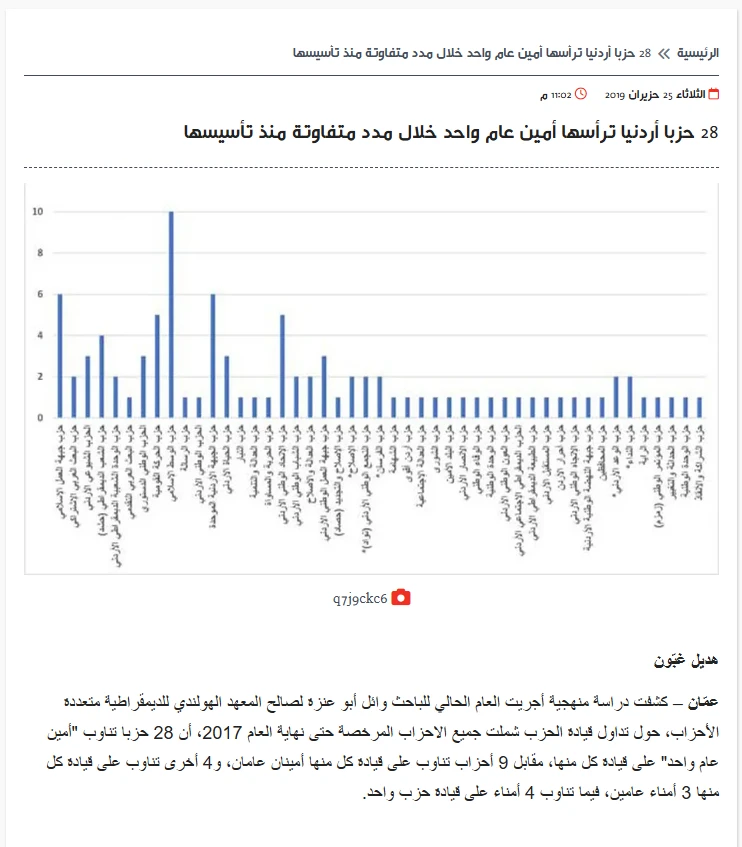
Internal Democracy
Original news reporting on leadership rotation across Jordanian parties.
Read original article ↗Syrian Employment & Investment
Lenner and Turner's article cites the Legatum and Re-Thinking Investment research.
View citing article ↗Democracy for the Next Generation
Closed panel discussion; full session listed on page 8 of the original conference booklet.
View conference programme ↗KPSRL Panel Media
NIMD's original posts document the event, including a panel photograph and a short pre-panel video.
Open NIMD's original post ↗Evaluation Matrix for Parties
Developed in 2019–2020 and later released by NIMD in English and Arabic.
View publication ↗Selected archival PDFs and primary-source images are now included. Further research downloads will be added when rights and source files are available.
Publications & research.
The complete available research archive, divided by public release status. Entries open to show institutional credit, your contribution and relevant evidence.
Showing all 15 research entries.
Published research
All 10 entries · newest first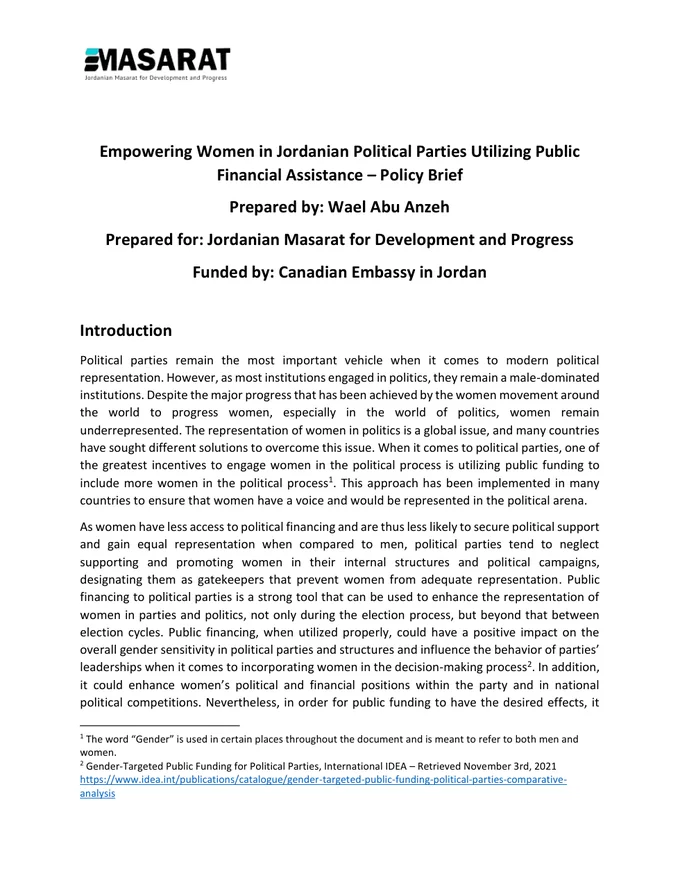
2024 onlineMethodologyEvaluation Matrix for Political Parties in the Jordan Context
Authors / research team: Wael Abu Anzeh
Institutional credit: Netherlands Institute for Multiparty Democracy (NIMD)
Developed a structured evaluation matrix enabling political parties and technical-assistance providers to assess institutional strengths and weaknesses beyond electoral results. The framework considers policy and programmes, internal democracy and institutionalization, outreach, inclusion and geographical presence. Designed as an adaptable diagnostic rather than a rigid ranking tool, it was used in the design of a targeted political-party capacity-development approach. The assessment results for individual parties were not intended for public release.
Developed around 2019; the online publication date is 2024.
Original publication and official sources
Use in institutional development
The matrix was developed around 2019–2020 to inform diagnostic assessment and targeted support for political parties, and was later published by NIMD online in 2024. Its importance lies in connecting an analytical tool to a sequenced party-development approach. Later NIMD technical guides and voter-information initiatives are related programme developments, not outputs attributed to the matrix or to my authorship.
2021Published researchEmpowering Women in Jordanian Political Parties Using Public Financial Assistance
Authors / research team: Wael Abu Anzeh
Institutional credit: Masarat for Development & Progress | Embassy of Canada in Jordan
Read or download archival copy
Original published document. Institutional credit and authorship are retained within each PDF.
Authored a policy brief examining how public financial assistance to political parties could strengthen women’s participation, leadership and electoral representation in Jordan. The study reviewed existing political and electoral regulations and proposed 31 measures covering representation in internal party structures, candidate recruitment and list placement, campaigning, gender-responsive spending, dedicated women’s activities and financial incentives. The research framed public funding as a tool for changing party practices beyond election periods. Subsequent political-party, electoral and party-financing reforms introduced several comparable mechanisms. This is documented policy alignment, not proof of direct legislative adoption.
Several recommendations align with later legal and financing reforms, but a direct causal influence has not been established.
Original publication and official sources
Related context and subsequent developments
Policy relevance / subsequent reforms
The 2021 brief proposed 31 ways to strengthen women’s position in party structures and electoral competition through public financing and institutional incentives. Jordan’s 2022 Political Parties Law and 2023 party-financing bylaw introduced related mechanisms, including requirements concerning women’s participation and additional funding linked to women elected. This demonstrates substantive alignment with later policy changes, not verified adoption of specific recommendations because of the publication. Some gender-related financing incentives predated the brief in the 2019 bylaw.
2020–2021Published researchStudy of the Gender Gap Between Male and Female Schools in Ajloun, East Amman, Madaba and Tafila
Authors / research team: Principal Researcher: Bashar Al-Khatib; Researchers: Rana Ibrahim Hassan and Wael Abu Anzeh
Institutional credit: Arab Network for Civic Education (ANHRE) | USAID Takamol, implemented by IREX
Participated in research examining gendered disparities in learning environments and outcomes across 32 public schools in four areas of Jordan. The study combined desk review with community-level data gathering and consultations to investigate infrastructure, resources, social norms, school-community relationships and educational barriers affecting boys and girls. Recommendations helped inform community-led initiatives involving schools, civil society organizations and families. The report is publicly available from ANHRE in connection with its gender-responsive community engagement project.
English and Arabic editions are held in the author archive; permission for website redistribution has not been confirmed.
Original publication and official sources
Related context and subsequent developments
2020Published researchA Close Look at the Status of Women and Youth in Jordanian Professional Associations
Authors / research team: Bashar Al-Khatib; Wael Abu Anzeh
Institutional credit: Arab Network for Civic Education (ANHRE) | Youth Academy for Democracy; Swedish IM-supported
Co-authored a baseline assessment examining women’s and young people’s representation, influence and participation in Jordanian professional associations. The study reviewed association structures, internal rules and leadership practices using desk research, stakeholder interviews and a questionnaire developed when pandemic restrictions limited conventional consultations. It identified institutional barriers and opportunities for inclusion and informed the Youth Academy for Democracy’s subsequent engagement and capacity-building work. A later ANHRE infographic summarizes the assessment; the infographic is not credited as my authored work.
The infographic summarizes research findings; it is not individually authored by the researcher.
Original publication and official sources
Related context and subsequent developments
Use beyond the study
This baseline assessment supported the Youth Academy for Democracy’s work on inclusion in professional associations. A later ANHRE infographic made the findings more accessible. The infographic and subsequent programming are related organizational outputs, not publications claimed as my individual work.
2020 onlinePublished researchJordan Political Parties Budget Analysis
Authors / research team: Wael Abu Anzeh
Institutional credit: Netherlands Institute for Multiparty Democracy (NIMD)
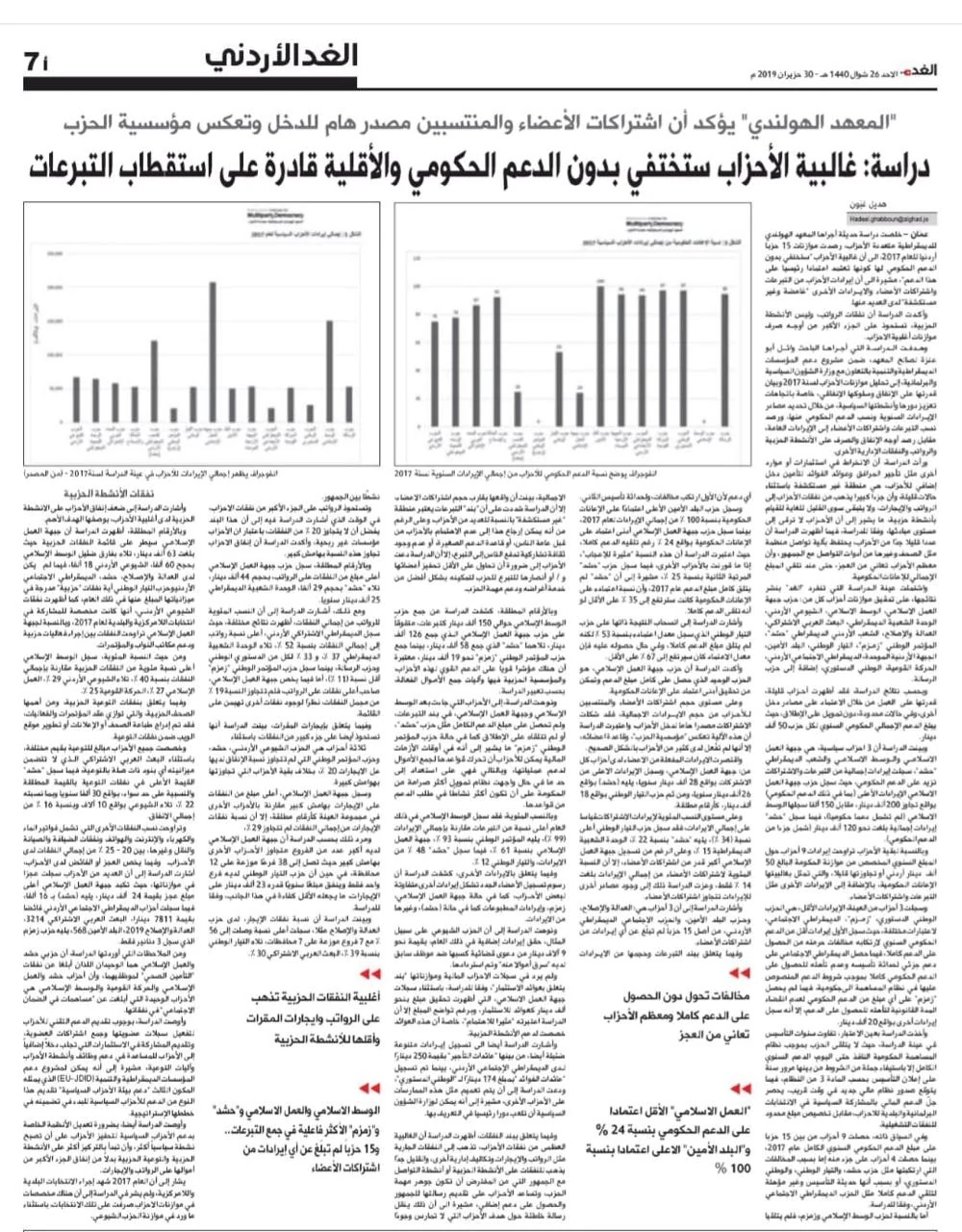
Authored a comparative analysis of the reported 2017 financial statements of 15 Jordanian political parties. The study examined public financing dependence, membership subscriptions, donations, salary and administrative costs, and expenditure on political activity. It identified structural challenges to financial sustainability and discussed implications for party institutionalization. The study received extensive national media coverage in Al-Ghad and was cited by political researcher E.J. Karmel in a November 2020 Middle East Report (MERIP) analysis of Jordan’s parliamentary elections. It was published during an active period of discussion about party financing, but the website does not attribute confidential policy advice or particular later bylaw provisions to the study.
Research was conducted in 2019 and released on NIMD’s website in 2020.
Original publication and official sources
Media coverage
Citations and educational use
Public and policy relevance
The analysis documented heavy dependence on state support, limited self-generated revenue and the balance between administration and political activity across 15 parties. It received national newspaper coverage and was subsequently cited in independent commentary on Jordan’s 2020 parliamentary elections. The 2023 financing bylaw later placed greater emphasis on electoral performance and representation. The research and later reform address overlapping challenges, without establishing a direct causal connection.
2020 onlinePublished researchJordanian Parties’ Internal Democracy – Brief
Authors / research team: Wael Abu Anzeh
Institutional credit: Netherlands Institute for Multiparty Democracy (NIMD)
Authored a comparative assessment of internal democratic practice and leadership rotation across 47 Jordanian political parties. The research analyzed how many individuals had occupied each party’s secretary-general position, their average tenure and differences associated with party age and succession practices. It documented that 28 parties had experienced a single secretary-general since their founding. Published as a companion to the budget analysis, the study generated substantial Al-Ghad coverage and contributed evidence to public discussion about institutional development and party governance.
Research undertaken in 2019; published online in 2020.
Original publication and official sources
Media coverage
Media coverage and subsequent use
Public discussion and policy context
The comparison of leadership succession across 47 parties—including the finding that 28 had retained one secretary-general since founding—received press coverage and contributed evidence to public discussion about party institutionalization. Subsequent political-party reforms expanded attention to participation and internal organization. Similar subject matter does not establish that the brief shaped specific legal provisions.
2019Published researchEconomic Policy in Jordan
Authors / research team: Dr. Yusuf Mansur; Bashar Al-Khatib; Wael Abu Anzeh
Institutional credit: Rosa Luxemburg Stiftung, Regional Office Palestine & Jordan | Funded by the German Federal Ministry for Economic Cooperation and Development (BMZ)
Co-authored an extensive political-economy analysis of Jordan's economic policy and structural vulnerabilities. The research traced how domestic policymaking, regional and geopolitical developments, external assistance and reform programmes shaped economic outcomes. It examined growth, public debt, IMF programmes, remittances, taxation, government expenditure and privatization, including the port, mining and electricity sectors. Combining historical and macroeconomic analysis with interviews and policy assessment, the study developed recommendations on structural economic challenges and resilience.
The report was published by Rosa Luxemburg Stiftung in June 2019 and formally launched in Amman on 18 June 2019, when the researchers presented their findings and engaged in discussion with scholars, civil society representatives and other participants.
These are selected documented citations and teaching uses, not a comprehensive citation count.
Original publication and official sources
Media coverage
Research uptake and relevance
Following publication and a public launch in 2019, this political-economy analysis was referenced in subsequent academic and policy-oriented research on Jordan’s economy and political conditions. These citations demonstrate that the study has been used by later researchers, not that it directly caused economic-policy changes.
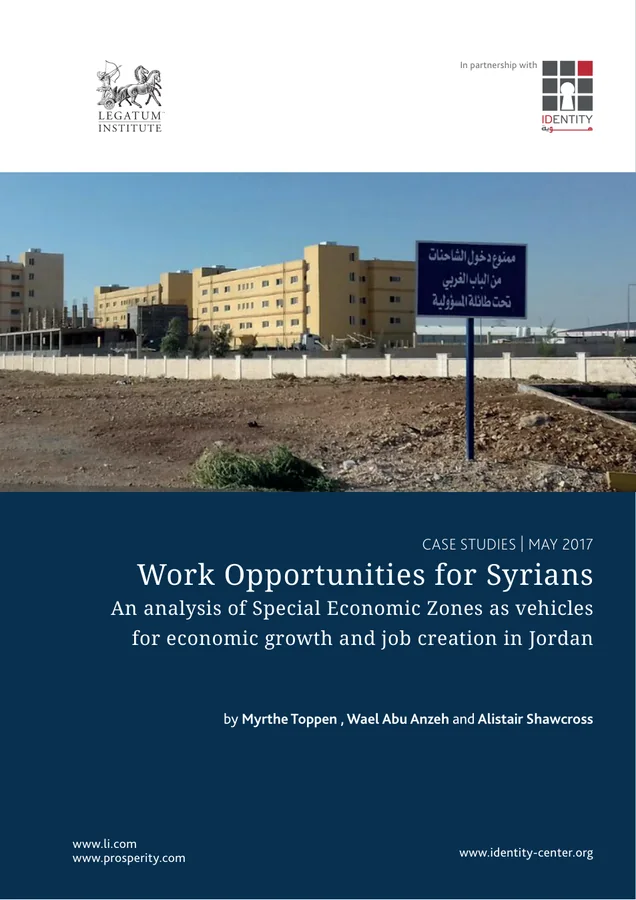
2017Published researchWork Opportunities for Syrians: An Analysis of Special Economic Zones as Vehicles for Economic Growth and Job Creation in Jordan
Authors / research team: Myrthe Toppen; Wael Abu Anzeh; Alistair Shawcross
Institutional credit: Legatum Institute, in partnership with Identity Center | Supported by the Legatum Foundation
Read or download archival copy
Original published document. Institutional credit and authorship are retained within each PDF.
Co-authored an early empirical assessment of the employment strategy associated with the 2016 Jordan Compact. The report tested whether Special Economic Zones, preferential access to European markets and increased investment could create sustainable employment for Syrian refugees and Jordanians. Combining economic and policy analysis with factory interviews, stakeholder consultations and focus groups with Syrian refugees, the study identified regulatory and institutional constraints, difficult working conditions and weaknesses in the proposed employment model. It advanced recommendations for economic development and labour-market inclusion grounded in evidence from the Compact's early implementation.
This archival copy is provided alongside source and academic citation links. The report was published in 2017.
Citations and educational use
Media coverage and subsequent use
Subsequent research uptake
The study examined the early labour-market assumptions behind the Jordan Compact and Special Economic Zone employment model. It was later cited in academic analysis of refugee labour-market integration, documenting uptake in subsequent research rather than implementation of its recommendations.
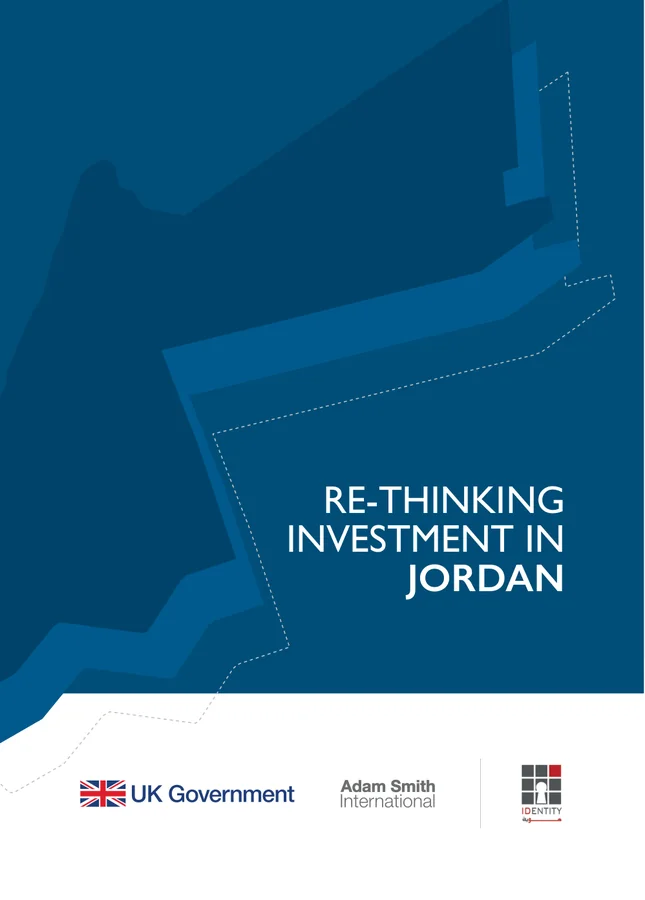
2016Published researchRe-Thinking Investment in Jordan
Authors / research team: Lead Researcher: Bashar Al-Khatib; Research Team: Aya Samara, Wael Abu Anzeh, Myrthe Toppen and Annie Hamill
Institutional credit: Identity Center | Adam Smith International | UK Aid support
Read or download archival copy
Original published document. Institutional credit and authorship are retained within each PDF.
Contributed to a detailed analysis of Jordan’s investment climate and the effectiveness of policies intended to attract domestic and foreign capital. The research assessed legislation, regulatory barriers, fiscal incentives, access to finance, labour-market conditions and Special Economic Zones, drawing on policy review and stakeholder perspectives. It identified structural obstacles and advanced recommendations to improve the investment environment while increasing economic benefits for Jordan. The study was referenced in later academic discussion of the Jordan Compact and economic zones.
English and Arabic editions are held in the author archive; redistribution rights are not yet confirmed.
Citations and educational use
Media coverage and subsequent use
Subsequent research relevance
The study evaluated structural barriers and incentives in Jordan’s investment environment and Special Economic Zones. Related issues were addressed in later academic discussion of the Jordan Compact and employment policy. The relationship is framed as thematic and citation-based relevance, not a claim that investment reforms followed from the report.
2016Published researchLabour Demands Forecast Research: ICT, Health and Green Energy
Authors / research team: Research conducted by Identity Center; individual named authorship requires confirmation
Institutional credit: Business Development Center (BDC) | UK Aid support
Contributed to labour-market research examining mismatches between educational outcomes and employer demand in the ICT, healthcare and green-energy sectors. The study combined official employment statistics with interviews and questionnaires completed by 57 companies, 23 in ICT, 22 in healthcare and 12 in green energy, to assess recruitment needs, skill gaps and sector prospects. It developed recommendations for better alignment of training and education with Jordan’s evolving labour market.
The contribution as researcher/co-author is based on the professional record; named authorship in the report itself still requires confirmation.
Original publication and official sources
Commissioned · not publicly released
All 5 entries · newest firstThese reports are described at a high level. Their documents are not available for download, as authorization for public distribution has not been established.
2021Commissioned · not publicEU Jordan Country Conflict Analysis (2021)
Co-authored a country conflict analysis examining drivers of instability in Jordan across domestic politics, regional geopolitics, rule of law, economic development and environmental pressures. Combining desk research and expert/stakeholder engagement, the report identified risks and recommendations intended to support conflict-sensitive programming and strategic development planning. This was a commissioned institutional report, not a public publication.
Commissioned institutional material. No report download is provided because public distribution is not authorized.
2020Commissioned · not publicIntegrating Youth in Developmental Processes (2020)
Co-authored a policy paper examining legal, administrative and public-finance obstacles to youth involvement in local development planning and decision-making in Jordan. The work drew on decentralization and municipal legislation, youth policy, government budgets and consultation evidence to propose options for participation, institutional reform and youth-led engagement, including shadow councils and monitoring mechanisms. Prepared for institutional use only.
Commissioned institutional material. No report download is provided because public distribution is not authorized.
2019–2020Commissioned · not publicJordan Integrity and Anti-Corruption Commission — Twinning Preparation (2019–2020)
Served as a key expert in institutional and legal assessment work supporting the development of a proposed EU Twinning arrangement for Jordan’s Integrity and Anti-Corruption Commission. The preparatory consultancy produced research and technical recommendations and a draft Twinning Fiche. The report itself was prepared for internal institutional use. A subsequent, modified public Twinning Fiche and later programme implementation are related outcomes, not documents identical to the original consultancy deliverables.
Commissioned institutional material. No report download is provided because public distribution is not authorized.
Related publicly documented programme
The original commissioned assessment and draft fiche were preparatory and are not publicly distributed. A public Twinning Fiche describes cooperation on integrity standards and corruption-risk assessment; the EU subsequently reported a programme launch in 2021 and completion in 2022. These are later institutional records, not evidence that I managed programme implementation or that the public document was identical to the original internal draft.
2018Commissioned · not publicJordan Fragility Assessment (2018)
Co-authored a multidimensional assessment of Jordan’s political, economic, institutional and regional vulnerabilities. The research team adapted relevant stability and fragility frameworks to Jordan’s context, developed an analytical index and examined power structures, inclusive growth, conflict-resolution arrangements, institutional legitimacy and regional factors. The findings were prepared to inform programme and policy decisions; the assessment was not intended for public release.
Commissioned institutional material. No report download is provided because public distribution is not authorized.
2015–2017Commissioned · not publicChild-Focused Public Finance & Budget Analysis in Jordan (2015–2017)
Led research and preparation of a series of national and sector budget briefs examining how public resources were allocated and spent in areas affecting children and vulnerable populations. The work covered the national budget, education, health, social protection, child protection and early childhood development. It combined multi-year expenditure comparisons, budget execution, sector performance indicators and programme-policy analysis to support informed institutional discussion of child-responsive budgeting, fiscal priorities and transparency. The materials were commissioned for institutional use and were not released publicly.
Commissioned institutional material. No report download is provided because public distribution is not authorized.
Show the record,
not just the claim.
Each entry distinguishes work undertaken, demonstrable outputs, citations, media mentions and subsequent policy developments. A citation or a later reform is not automatically evidence that a specific publication caused it.
Original publisher links are retained where available. Downloadable archival copies can be added later for documents whose redistribution rights permit hosting. Unpublished commissioned materials remain private unless release is authorized.